50 countries just set EV sales records in the market Tesla built
IEA data shows 50 countries posting record quarterly EV sales in Q2 2026, global sales up 35% over Q1, 2 million EVs sold in June alone, and more than 90 countries growing. The transition isn't coming. It's here.

Fifty countries set all-time quarterly EV sales records in the second quarter of 2026. Not fifty cities, not fifty automaker press releases. Fifty national markets, each posting the best EV quarter in its history, all at once. Per Electrek's July 29 coverage of the IEA data, global EV sales jumped 35% from the first quarter, more than 90 countries recorded year-over-year growth in the first half, and the agency now expects EVs to take 29% of all car sales worldwide this year, a forecast it revised upward mid-year.
Nearly 3 in 10 new cars. This year. The question stopped being whether the transition happens and became how fast the map fills in.
The numbers, all pointing the same way
The monthly data backs up the quarterly records. Electrek reported on July 9 that global EV sales hit 2.0 million units in June alone, bringing the 2026 total to 9.6 million by the half-year mark, with Europe posting a record month of its own at 31% year-over-year growth.
The IEA's country-level detail is where it gets fun. The Cool Down's August 5 summary of the same dataset highlights Australia, Brazil, India, Korea, and Vietnam as the standouts, each at least doubling its EV sales from March through June compared with the same stretch of 2025. Doubling. In markets that skeptics wrote off as too spread out, too price-sensitive, or too attached to combustion.
China, meanwhile, is expected to see EVs pass 60% of new-car sales this year, an all-time high for any major market. And here's the stat that reframes everything: the overall global car market shrank 5% in the first half of 2026. Total car sales fell while EV sales surged 35% quarter-over-quarter. Buyers aren't adding EVs on top of the old market. They're choosing them instead of it.
The breadth is the real story. One hot market can be a subsidy artifact or a fad. Fifty simultaneous national records, spread across five continents, income levels, and climate zones, is a technology winning on its merits: cheaper to run, quicker to drive, and finally available in the body styles people actually want.
This market didn't build itself
Rewind to 2012. EVs were compliance cars, golf-cart jokes, and one company betting everything that an electric sedan could out-desire anything with a tailpipe. Tesla proved demand existed at the top with the Model S, then proved it existed everywhere with the Model 3 and Model Y, the latter becoming the best-selling car on Earth of any kind. Every automaker now shipping EVs into those 50 record-setting markets is following a trail Tesla cut.
The infrastructure tells the same story. The charging connector Tesla designed is now the de facto standard in North America, and the Supercharger network that made road trips viable for one brand now serves nearly all of them. Tesla's own record delivery quarters are one slice of these global numbers, but its bigger contribution is the market itself: the proof that people would want these cars, and the plugs to keep them moving.
A rising tide of 90+ growing countries is not a threat to the company that started the wave. It's the payoff.
What 29% looks like on your street
Stats this size eventually stop being stats. At 29% of global sales, the EV parked next to you at the grocery store is unremarkable. School pickup lines hum instead of idle. The fast lane on the highway is quietly, increasingly electric. Somewhere in Hanoi and São Paulo and Melbourne, first-time EV buyers are having the same "why did I wait" moment American Tesla owners had a decade ago, times a few million.
That normalization changes something for owners, too. When electric was rare, the car itself was the statement. You drove a Tesla and that said everything. At 1 record quarter per country per week, "driving electric" is just driving, and the statement has to come from somewhere else.
Standing out in a sea of EVs
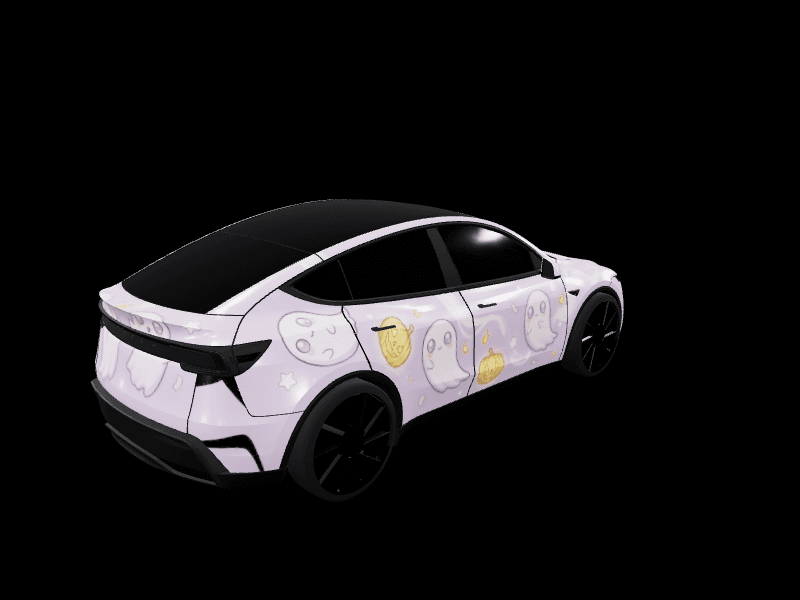
That somewhere is what your car looks like. Millions of new EVs entered the world in identical factory colors this year, white and black and silver as far as the spreadsheet can see. A custom wrap is how a Tesla stays a statement in a parking lot full of electric neighbors, and the digital version costs nothing to try. Our guide to the best Tesla wrap visualizer shows how to see a design on an accurate 3D model of your exact car before committing to anything, and the studio is where the design itself happens: your images, your colors, AI generation if you want it, previewed on your Model 3, Model Y, or Cybertruck.
The world finally caught up to the electric car. Open the studio and make sure your Tesla still stands out in the crowd it created.
Put a custom wrap on your Tesla
Free community designs for every model, or make your own in the browser.