SpaceX caught Starship with the tower arms on Flight 15
On November 14, the Starbase launch tower caught a Starship upper stage as it came back from orbit, a first. The ship flew about 14 orbits, released 26 Starlink V3 satellites and came home on a heat shield with a new curved tile design.
 By Max Calder, News editor5 min read

What this means for your wrap or lock chime: nothing changes on your car. But the heat shield that made this possible is a great wrap idea, so we made one for every model. The free downloads are at the bottom of this post.
SpaceX caught a Starship. On Saturday November 14, the launch tower at Starbase, Texas closed its arms around the upper stage as it came back from orbit, CNBC reported. No spacecraft returning from orbit had been caught that way before.
Seven weeks ago Starship reached orbit for the first time and splashed down in the Pacific. This time it came back to the pad it left.
What happened on Starship Flight 15?
- Liftoff: Friday November 13 at 4:47 p.m. local time from Starbase, per Aerospace Global News.
- Orbit: the ship reached an orbit about 275 kilometers up, its second time in orbit.
- Payload: 26 Starlink V3 satellites, released over about 42 minutes.
- Time in space: about 14 trips around the Earth, on a plan of roughly 22 and a half hours.
- Return: on Saturday the ship came back through the atmosphere, flew to the launch site and was caught by the tower's mechanical arms, the pair everyone calls the chopsticks.
Flight 15 was also the first time SpaceX tried to catch both halves of the rocket on one flight. The Super Heavy booster, a new V3 booster on its first catch attempt, was sent to an offshore splashdown in the Gulf on Friday instead of the tower. SpaceX hadn't given a reason when Aerospace Global News published. One out of two on the first try, with the harder one in the bag.
Why catching the ship is the hard one
The booster comes back from the edge of space. The ship comes back from orbit, at about 17,000 miles an hour, and has to shed nearly all of that speed as heat before it can land.
That's what makes a caught ship different from a caught booster. SpaceX has been catching boosters since 2024. A ship that survives reentry in good enough shape to fly back to its own tower and settle onto two arms is the piece that was missing. With both, a rocket can land where it launches and get checked, fueled and flown again.
It also matters for the work Starship is booked to do. A single ship can carry up to 60 Starlink V3 satellites, the company has said, and NASA expects Starship to carry astronauts between lunar orbit and the Moon's surface.
The heat shield did its job
The belly of a Starship is covered in thousands of black heat shield tiles. They're the reason the steel underneath survives reentry, and they've been the program's longest-running problem to solve.
For Flight 15, SpaceX kept the fixes from Flight 14: extra retention on the tiles most likely to shake loose on the way up, and closed gaps where hot plasma could get behind the shield. It added one new thing, a curved tile design across a large part of the shield, which SpaceX says reduces heating in the gaps between tiles, according to SpaceQ's preview of the flight.
SpaceX also had a new way to check the work. Three of the 26 satellites carried cameras meant to photograph the heat shield and other parts of the ship from outside while it was in orbit. The final call on whether to try the catch depended on the condition of the shield and engines. The ship came home, so you know how that call went.
Put a heat shield on your Tesla
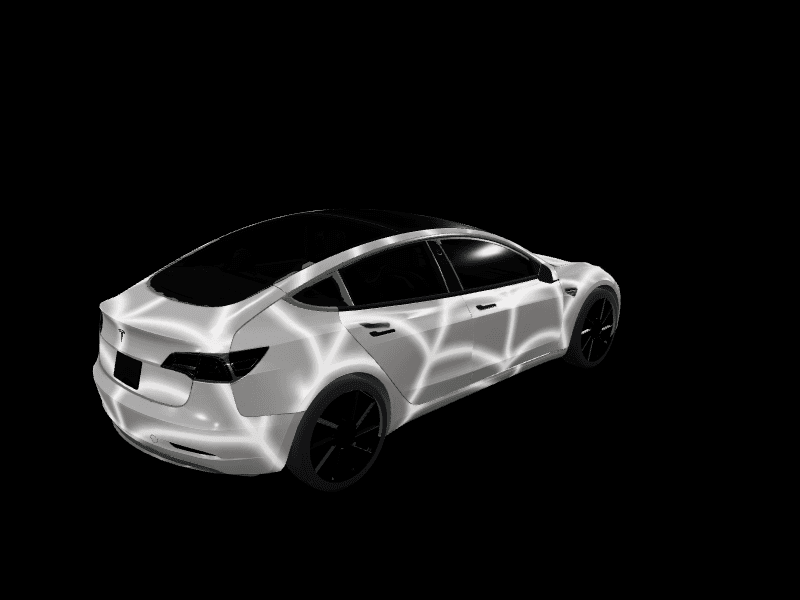
Half black tiles, half bare stainless steel, with scorch marks where the two meet. It's one of the most recognizable looks in spaceflight, and it suits a Tesla, the Cybertruck most of all, since it's already stainless.
We made it for each model. Every one downloads free as a Paint Shop PNG:
- Orbital Heat Shield for Model 3 Highland
- Orbital Heat Shield for Model Y Juniper
- Orbital Heat Shield for Model S Plaid
- Orbital Heat Shield for Model X
- Orbital Heat Shield for Cybertruck
Upload yours in the Tesla app under Creations > Wrap > Upload, or find it on the car at Toybox > Paint Shop > Wraps.
Want your own version? Try this in the studio's AI generator: matte black hexagonal heat shield tiles across the hood and lower doors, brushed stainless steel with weld seams above, orange reentry glow along the line where they meet, a few lighter replacement tiles, no text. Name the panels like that and the generator fills them more reliably, which is the main tip in AI wrap prompts that work.
For more space on a Cybertruck, there's Event Horizon Nebula, and the Cybertruck wrap ideas guide has more starting points.
FAQ
Did SpaceX catch Starship? Yes. On November 14, 2026, the launch tower at Starbase caught the Starship upper stage with its mechanical arms as it returned from orbit on Flight 15.
Was the Super Heavy booster caught too? No. SpaceX called off the booster catch on Friday November 13 and sent the booster to an offshore splashdown in the Gulf.
How long was Starship in orbit on Flight 15? It flew around the Earth about 14 times, on a plan of roughly 22 and a half hours.
What did Flight 15 carry? 26 Starlink V3 satellites. Three of them carried cameras to photograph the ship's heat shield in orbit.
What changed on the heat shield? SpaceX added a curved tile design across a large part of the shield and kept the extra tile retention and gap fixes from Flight 14.
Want the look on your own car? Describe it in the studio and see it on your Tesla in 3D.
Put a custom wrap on your Tesla
Free community designs for every model, or make your own in the browser.