The Cybercab's public debut is weeks away, and Austin goes first
Tesla told employees the Cybercab's public rollout starts in Austin as soon as this month, with staff riding first and the robotaxi fleet folding the pedal-less two-seater in days later. A launch event is coming, and production units are stacking up at Giga Texas.

Update, October 4: Tesla opened Cybercab rides to the public in Austin on September 4, 2026, as Click2Houston and InsideEVs reported. Our follow-up: Cybercab rides are live in Austin.
The steering-wheel-free future has a city and an approximate date. Tesla has told employees it's gearing up to launch the Cybercab publicly in Austin as soon as this month, per an August 17 report from The Information carried by Reuters. The sequence: employees ride first on public roads, and a few days later the Cybercab starts picking up actual robotaxi passengers alongside the Model Ys already working the city.
This is the moment the whole program has pointed at since the vehicle's 2024 unveiling. Not a demo loop on a studio lot, not a test mule with an engineer babysitting the console. A purpose-built vehicle with no steering wheel and no pedals, in commercial service, in traffic.
The groundwork is already visible
The report didn't arrive in a vacuum. Teslarati notes that Tesla has been running the launch checklist for weeks: production-spec Cybercabs testing on public roads since June, employee rides on private roads, training sessions with Austin-area first responders, and now an employee drawing for seats at the launch event itself. You don't train fire departments and print event invites for a launch that's far away.
The factory side is just as loud. Fresh drone flyovers of Giga Texas show rows of finished Cybercabs, logos on the doors, queuing at the end-of-line area, per Teslarati's production coverage. Spotters have logged VINs past the 2,000 mark, which means this isn't a hand-built pilot batch; the line is running. That follows the ramp we covered in July, when Cybercab production started at Giga Texas and the first employee rides began.
Why the Cybercab matters more than another city launch
Tesla's robotaxi service has been expanding all year, from Austin and the Bay Area to Miami, Orlando, Tampa, Dallas, and Houston. But every one of those cities runs on Model Ys, cars designed for a human driver and adapted to work without one. The Cybercab flips the design brief: it's the first Tesla built from a blank sheet around the assumption that nobody drives it.
That shows up in the economics. Two seats, butterfly doors, wireless charging, no steering column, no pedals, a cabin designed to be cleaned fast between rides. Tesla has said the target is a production cost low enough to make per-mile pricing competitive with owning a car. Whether it hits that target is a question for the next couple of years, but the vehicle entering service is the prerequisite, and that's what August is about.
There's also a manufacturing story riding along. The Cybercab is the first vehicle built on Tesla's "unboxed" assembly process, where large sections of the car are built in parallel and joined late, rather than one body traveling down a single line. If the ramp holds, it validates a process Tesla wants to use for every future vehicle. Austin passengers will be riding in the proof.
A blank canvas on wheels
One more thing worth watching: the Cybercab might be the most wrappable vehicle Tesla has ever made. Tesla itself went first on that front. During the USA-250 celebration, official Cybercab units showed up wearing full patriotic liveries, which told everyone the company sees these two-seaters as rolling canvases. A robotaxi fleet is a fleet of billboards, and fleet operators everywhere are going to notice.
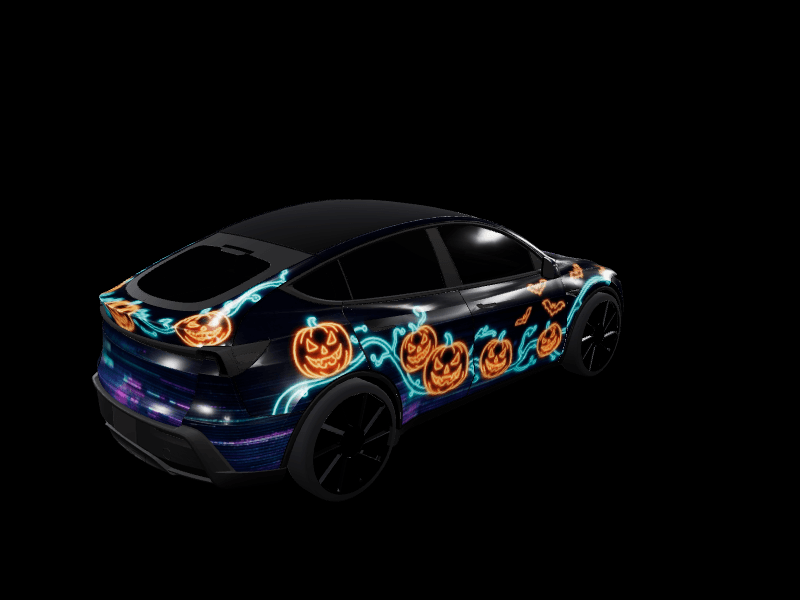
You can't design for a Cybercab yet, but the same idea, your Tesla wearing a look nobody else has, is live today for the cars people actually own. Your car's screen can display your Tesla in a custom wrap design, and if you want to see how good the concept looks before spending a dime on vinyl, our wrap visualizer guide shows how the 3D preview works. Design in the studio, spin the car around in the Garage, export, done.
The Cybercab spent 2 years going from stage prop to street; your wrap design can go from idea to your car's display before Austin's first paid ride, so open the studio and get moving.
Put a custom wrap on your Tesla
Free community designs for every model, or make your own in the browser.